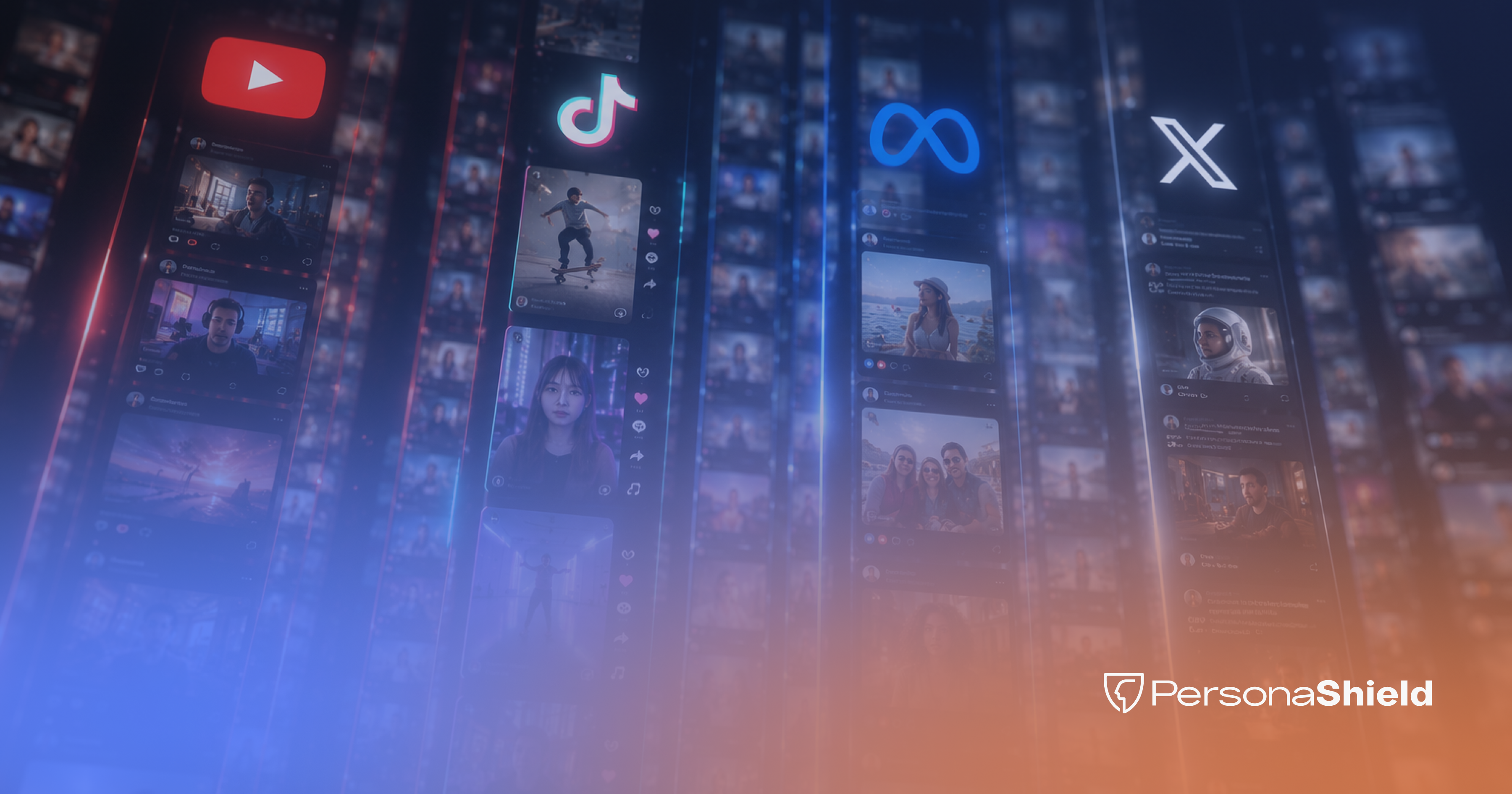
If you found an AI fake of yourself two years ago, the only thing to do was fill in a general report form and wait. That has changed, and three of the four platforms in this article have now built something specific to likeness.
None of it has solved the problem. There are more AI fakes now than there were before any of these tools existed. The most developed one is still labeled experimental by the company that built it, and the other two are either very narrow or barely available.
Some of that is just early days. These are real products that did not exist two years ago, and they are being built while the technology underneath them keeps moving. The rest is harder to separate from what these companies are weighing. These are engagement businesses, and content built on recognizable faces travels, so the reason to take it down runs against the reason to leave it up.
What exists so far is a way to find some of what is already out there. Whether any of them goes further is the open question.
Why Social Platforms Are Updating Their AI Policies
None of this was any one company's plan. Three pressures arrived close enough together that the response looks coordinated even though it was not, and they built on each other in roughly this order. The first is the simplest to see.
1. Volume
Image and video models got good enough, fast enough, that making a convincing fake stopped being a specialist project. What platforms once handled as a rare escalation turned into a category, and categories need systems.
2. Creators and their representatives pushed back
Creators raised it first. In 2023, a deepfake ad of MrBeast ran on TikTok. He asked publicly whether social media platforms were ready to handle the rise of AI deepfakes, and called it a serious problem. Three years on, the tools in this article are the closest thing to an answer anyone has offered.
The companies that represent creators then made the same case at scale. Agencies sit in the middle of the creator economy now, and they have been clear about wanting protection on by default rather than buried in a settings menu.
3. Regulation
One law is already in force. The TAKE IT DOWN Act reached full enforcement in May, requiring covered platforms to remove nonconsensual intimate imagery, including AI-generated versions, within 48 hours of a valid report. The FTC enforces it.
More is close behind. The EU AI Act's transparency obligations became applicable on August 2. Providers of generative systems have to mark synthetic output in a way machines can read, and anyone deploying one has to disclose deepfakes. In the US, the NO FAKES Act cleared committee unanimously in June and now sits with the full Senate. Our breakdown of what it means for creators covers what it would establish.
How Major Social Platforms Are Responding
There is no shared standard here. Each company decided on its own what a likeness tool should do, who should be allowed to use it, and what it should be permitted to find. The four answers came out very different. Start with the one that has built the most.
1. YouTube
YouTube's is the most developed, which mostly tells you how early all of this still is. It started inside the Partner Program. In March 2026 it opened to a pilot group of government officials, journalists, and political candidates. Talent agencies including CAA, UTA, and WME followed in April, and all creators over 18 in May.
You set it up in YouTube Studio under Content detection, verifying with a government-issued ID and a short selfie video that doubles as the reference the system matches against. Verification can take up to five days. From there it scans new video uploads across YouTube and queues anything it flags for you to review. YouTube's own documentation is unusually direct about the limits.
- Experimental, and unavailable in some countries.
- Faces only. Audio was named for 2026 and has not shipped.
- It can surface real footage of you, and it can miss AI-generated videos entirely.
- Detection does not guarantee removal, since parody and satire get weighed in review.
2. TikTok
TikTok confirmed in July that it is testing an opt-in likeness detection tool with a small group of US creators. It scans for AI-generated content that appears to use an enrolled creator's face and surfaces matches for review.
Creators verify through Jumio, a third-party provider, using a real-time selfie and a government ID check. TikTok has said it does not keep the ID documents and uses facial information only for likeness matching.
TikTok got one thing right that the others did not. Matches go to the creator, who decides what to report, so nothing moves until a person has looked. That matters when a parody, a news clip, and a fan edit the creator actually likes can all trip the same match.
Everything else is closed. There is no way to request access, no expansion date, and no plan beyond the US.
3. Meta (Facebook and Instagram)
Meta's runs in two places, and neither of them is your feed.
The first is advertising. When the ad review system flags a suspected celeb-bait ad, facial recognition compares the face in it against the public figure's profile photos. A confirmed match gets the ad blocked. The second is impersonation accounts, where Meta compares the profile picture on a suspicious account against the real person's and removes the account if they match. Both are opt-in for public figures and run in the UK and EU after regulatory approval.
An ordinary post is covered by neither. If someone generates an AI image of you and puts it straight in their feed, rather than behind ad spend or a fake account, nothing scans it.
Meta's has run longer than any of the others, so there is more to look at. Most of what exists measures ad enforcement overall rather than the matching itself. In 2025 the Tech Transparency Project found 63 scam advertisers running over 150,000 political ads worth $49 million, many using deepfakes of public figures. All 63 had already had ads pulled by Meta, and nearly half were still running new ones. TTP has since traced a network of nudify-app ads to one of Meta's own business partners.
How much of that the tool was ever meant to catch is unclear. It is narrow by design, and narrow enough to run exactly as intended while missing most of what is out there.
4. X
X has built nothing. No enrollment, no queue, no dashboard.
What it has is a general-purpose image generator inside the platform, which puts the generator and the people being generated on the same platform. Its response has come after the fact each time, including restricting image generation to paying subscribers in January after sustained criticism over sexualized deepfakes. Those are moderation decisions, not something a creator can switch on.
Where Platform Likeness Tools Still Fall Short
Two things did get better. Likeness is its own category now rather than whichever bucket the report form offered, and verified enrollment means a claim belongs to the person whose face it is. Past that, the same problems keep showing up across all four.
1. Enrolling asks for more than the job requires
Protection does not travel. Signing up on one platform does nothing for you on the next, so covering yourself means enrolling separately everywhere it is offered. Only YouTube's is broadly available, and even that is limited by country.
Handing over a reference of your face is unavoidable, since nothing can look for your likeness without knowing what it looks like. The friction is what sits on top. YouTube wants a government ID alongside the selfie and ties your full legal name to the record. It holds face templates and identity data for up to three years from your last sign-in. TikTok routes the same combination through a third-party provider. That is roughly the standard you would meet to open a financial account, for a job that is closer to matching a photo.
CNBC reported in December that experts were alarmed by sign-up language suggesting Google could train AI models on that biometric data. YouTube said it never has, while confirming it would not change the underlying policy. Creators have publicly said they will not hand that over, which is worth remembering when a rollout is described in terms of how many people are eligible.
2. Nothing stops it at the point of posting
Everything here runs after publication. Something gets made, something gets posted, the system catches it or does not, and then you review and file. By then it has already reached whoever it was going to reach.
These platforms already scan uploads before they publish, for copyright and for ad suitability, and likeness matching is the same kind of scan pointed at a face. Running it at the point of posting would catch something before an audience does. No platform has announced anything like it.
3. No tool lets you go looking for AI images of yourself
YouTube's covers video, and its documentation says so plainly. TikTok has not published what its test covers, and most reporting describes it as scanning AI-generated videos. Meta does match faces in images, but only in ads and impostor profile pictures, and it acts on them automatically rather than showing you anything.
So on none of the four can you sit down and look through AI images of your own face the way an enrolled creator can look through videos. Images are cheaper to make and easier to repost, and they travel through forums, prompt-sharing communities, and messaging apps with no likeness tool at all. Our guide to detecting and removing deepfakes of yourself online covers the habits that fill that gap, and they only scale so far.
4. Filing a takedown is not the same as getting one
Submitting a report is easier than it has ever been, and that improvement gets talked about as though it were the finish line. YouTube states plainly that it will not remove all content, and UN News reported in March that tech companies often run opaque and inconsistent reporting processes and issue automated rejections. The Meta figures say it another way, since advertisers whose ads were pulled kept running new ones.
What you need to know is whether it came down, and that has not kept pace with how easy it got to ask.
The Difference Between Opt-Out and Opt-In
Running underneath all of this is an argument about defaults, meaning whether your likeness is available for AI generation until you say otherwise, or unavailable until you say yes.
Meta launched Muse Image on July 7. One capability let anyone generate images by @-mentioning a public Instagram account. Every adult public account was included unless the person found the setting and turned it off. Three days later Meta removed that capability, saying it had missed the mark, though the images already generated stayed up.
The language is the part worth noticing. Meta answered the criticism by pointing out that people could opt out with a couple of clicks, which was true and was also the problem. An opt-out is a setting you have to know exists, find, and switch off before anything happens to you. An opt-in is a question someone asks you first.
CAA had called for that reversal two days earlier, asking Meta to make protection the default. The agency went further than the launch itself. It argued that no one's name, image, likeness, voice, or creative work should be used by any third party without clear, documented consent. It also said creators should be able to set restrictions, monitor usage, and prevent unauthorized endorsements. SAG-AFTRA told its members to switch the setting off.
WME had raised the same objection when Sora launched, opting its full client list out, and Sora later moved to opt-in. Two launches, two rounds of the same complaint, two retreats.
What's Next for AI Likeness on Social Platforms
The near term depends on whether these tools grow into anything more. YouTube named 2026 for audio matching and it has not arrived, which leaves a cloned voice over real footage outside every system described here. TikTok's test has not moved since July. The signs it is becoming a real product would be a public waitlist, published accuracy figures, or a second market, and none has appeared.
More of the weight sits with regulation now, because the platforms have had two years and the problem grew over the same period. The EU AI Act's marking rules carry a grace period to December, and the NO FAKES Act still needs a full Senate vote.
The bigger question is whether anyone shifts from removal to authorization. Detection can only tell you what was made about you, while authorization would let you decide what can be made. That is where PersonaShield starts. You set your safeguards once, and the same rules decide what gets flagged for removal and what your fans can officially create, with you earning from every image. No platform has a reason to build that for you, which is why it has to exist somewhere else.