Karen Flowers built a following of more than 90,000 people around hair care. She is a licensed cosmetologist in Virginia, and her YouTube channel runs on tutorials, product breakdowns, and short videos about curls.
In April 2026, her followers started seeing an AI-generated ad in which she sold life insurance, a product she had never heard of. "I know what I look like," she told InvestigateTV. Nobody paid her, and nobody asked.
That pattern has a name now, and it is happening at volume. AI-generated endorsements work because a familiar face does most of the persuading before anyone reads a word.
The account behind one usually disappears within days. The association it created does not. Followers lose money, brand partners notice, and the creator is left explaining a transaction they had no part in.
What Is an AI-Generated Endorsement?
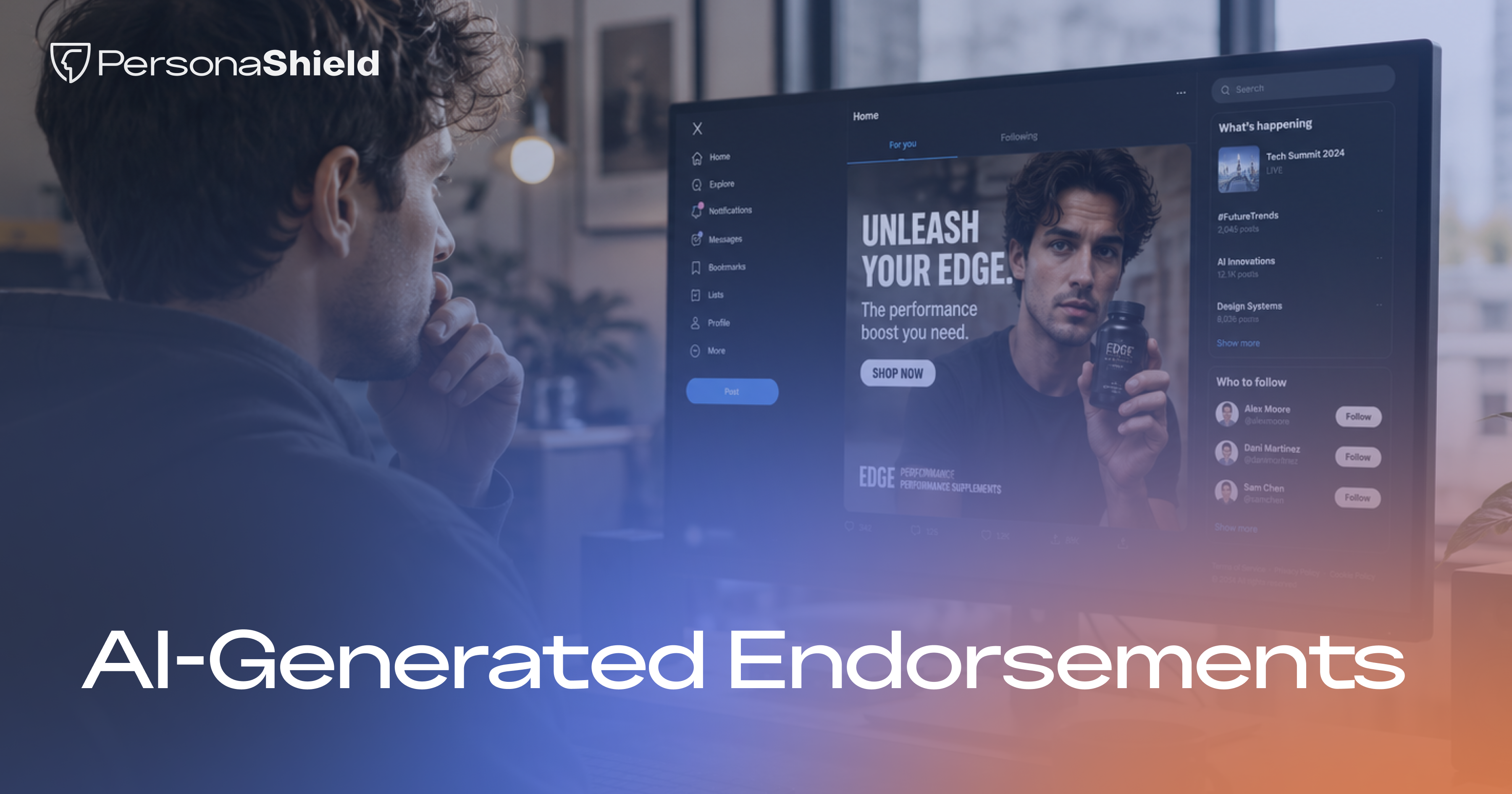
An AI-generated endorsement is synthetic content that uses someone's face, voice, or name to imply they recommend, approve of, or are paid by a product, service, or company, without that person agreeing to any of it.
It tends to show up in four formats:
- Fake advertisements. Paid placements running a cloned voice over recycled footage.
- Sponsored posts. Organic-looking content from accounts that mimic a creator's handle, styling, and posting rhythm closely enough to pass a scroll.
- Product promotions. Single images or short clips showing a creator holding, wearing, or using something they have never touched.
- Full brand campaigns. Coordinated assets built around a likeness, sometimes with a fake landing page, invented press coverage, and a checkout flow.
Intent is the dividing line. Fan art, parody, and entertainment edits use a likeness to celebrate someone or make a joke, and audiences read them that way. A fake endorsement is built to sell.
That line matters legally too. US advertising rules already treat an endorsement as a claim that has to be truthful and substantiated, which makes a synthetic endorsement a consumer protection problem on top of a likeness one. For the friendlier side of this, we covered how AI generation can work with creator permission.
Why AI-Generated Endorsements Can Damage a Creator's Reputation
The content itself is usually cheap and often sloppy. The damage is neither, because a fake endorsement lands on the exact relationship a creator's business runs on.
1. They Can Break Audience Trust
Creators convert because audiences believe them. Deloitte's 20th Digital Media Trends survey, published in March 2026, found that 52% of fans treat social platforms as their primary way of discovering new content, rising to 73% among Gen Z, which puts the people posting on those platforms in charge of what their audiences try next.
That trust is built slowly, through years of a person being consistent about what they will and will not put their name on. A fake endorsement spends it without asking.
Some followers buy the product. Others recognize it as fake and still carry a small doubt into the next real post, which is the more expensive outcome, because it is invisible and it compounds.
2. They Can Affect Brand Partnerships
Brand deals are priced on exclusivity, category fit, and reputation. A creator who appears to endorse a competing product, a regulated financial service, or an obvious scam creates a problem for partners who wrote none of that into the agreement.
The pressure runs the other way too. In July 2026, Amber George, who spent 14 years as the on-air spokeswoman for a Spokane appliance retailer, sued the company and its production agency over a holiday commercial featuring her that she had never filmed, assembled from her past footage. She was offered a contract addendum permitting AI use, and ended the relationship instead.
Bloomberg Law has reported that expansive AI alteration language is now being written into influencer contracts with little fanfare, which means some creators have already signed away rights they would want back.
3. They Can Spread Faster Than Corrections
Speed is structural. The reference study on this, run at MIT and published in Science in 2018, remains the largest analysis of how information travels online. It found that false stories reach far more people and travel roughly six times faster than accurate ones, largely because people share them rather than bots. Nothing since has reversed that finding, and generative tools have only made the content cheaper to produce.
Fake endorsements inherit that behavior. A takedown removes the original upload, and the screenshots, reposts, and aggregator accounts stay up across platforms the request never touched.
A creator's correction reaches the people who already follow them. The fake reaches everyone the algorithm sent it to, which is a far larger audience with no reason to recognize that anything is wrong.
4. They Can Be Used in Scams
The most organized use of synthetic endorsements is fraud. The FBI's Internet Crime Complaint Center broke out AI-related crime as its own category for the first time in its 2025 report, logging 22,364 complaints and roughly $893 million in reported losses.
The formats repeat: crypto pitches promising to double a deposit, fake giveaways that harvest personal information, spoofed investment sites dressed up as financial media, and counterfeit storefronts trading under a creator's name.
Correcting one can cost more than the fake did. Tom Hanks warned followers in 2023 about an AI version of him promoting a dental plan, then posted a second warning in 2024 about ads using his likeness to sell miracle cures. To make that correction credible, he disclosed that he has type 2 diabetes and works only with his own doctor. A fake endorsement had made a private medical detail the price of setting the record straight.
Why Creators Are Especially Vulnerable
Public figures with legal teams get impersonated constantly, but creators sit in a position that makes them unusually efficient targets.
The face is recognizable to a specific, engaged group, which is all a scam needs. The audience is reachable, so a fake ad can be aimed at followers of the real account. Recommendations already carry weight, so the endorsement reads as plausible. Sponsored posts are normal in the feed, so a company nobody has heard of raises no flag.
The raw material is public too. Years of uploads provide clean, well-lit footage of a face and voice from every angle.
Underneath all of it is a resourcing problem. A studio or a league has counsel, a communications team, and platform relationships that get a call answered.
A creator at the scale Flowers works at is running the business alone, and is expected to notice the fake, document it, file the report, chase the reposts, and reassure the audience.
What to Do If Your Likeness Appears in a Fake Endorsement
Most states protect a person's name, image, and likeness from unauthorized commercial use, and a fake endorsement is about as clean an example of that as exists. The complication is who sits on the other side.
When the responsible party is an identifiable company, those protections carry real weight, which is why cases like George's get filed. When it is an anonymous account buying ads from outside the country, there is frequently nobody to serve, and the realistic remedy becomes removal rather than damages.
Federal help is still pending. The FTC has proposed extending its impersonation rule to cover individuals but has not finalized it, and our breakdown of what the NO FAKES Act means for creators covers where a federal likeness right would fit.
An immediate response can look like this:
- Capture everything first. URL, account handle, screenshots, timestamp. Removal destroys the evidence you may need later.
- Report it on the platform. Use the impersonation process, and the paid advertising path as well if it is running as an ad, which is often reviewed separately and faster.
- Tell any real brand named in it. Their trust and safety contacts can escalate in ways an individual report cannot.
- Keep watching. Reposts outlive the original.
If money changed hands, victims can also file with the FTC at ReportFraud.ftc.gov.
Why Protecting Trust Matters as Much as Protecting Likeness
A likeness has value because of what sits behind it. Audiences respond to a face because they have watched that person be consistent over years, and that history is the asset.
A fake endorsement copies the appearance in order to reach the credibility. That is the part that took years, and the part that cannot be regenerated.
Two things follow from that. The first is to read what you sign. AI alteration language is turning up in ordinary influencer agreements, and a clause letting a partner modify your footage is easy to miss and difficult to undo later.
The second is to put safeguards around the likeness itself, so unauthorized commercial use surfaces early rather than through a follower's message weeks later. That is what PersonaShield is built for. A creator sets their safeguards once, and those safeguards drive monitoring and takedowns across the places their likeness is likely to appear.
For a creator, protecting a reputation and protecting a likeness have become the same job.